




A Promise to Her Sister: Iris Cantor and Four Decades of Breast Cancer Care
A Promise to Her Sister: Iris Cantor and Four Decades of Breast Cancer Care
How a personal loss became one of the most enduring commitments to women’s health in American philanthropy
This October is the first Breast Cancer Awareness Month without Iris Cantor. For many people, her name calls up museums: the Rodin galleries she and her husband, B. Gerald Cantor, helped build across the country, or the Cantor Roof Garden at The Metropolitan Museum of Art. But some of her most lasting work happened far from any gallery, in mammography suites, exam rooms, and community clinics on both coasts. That work began with a loss.
A Brooklyn-born pioneer
Iris Cantor was born and raised in Brooklyn and started her career on Wall Street at a time when very few women worked there. Through that work she met Bernie Cantor, founder of Cantor Fitzgerald and the world’s leading private collector of Auguste Rodin’s sculpture. In 1978 the two established the Iris & B. Gerald Cantor Foundation to support medical, educational, and cultural institutions in the United States and abroad.
The arts were the Cantors’ shared passion. Women’s health became Iris’s own. Her younger sister was diagnosed with breast cancer and died from the disease, and Iris turned that grief into a lifelong mission: making sure other women could find the disease earlier and get care sooner.
1986: Starting with early detection
Her first major step was the Iris Cantor Center for Breast Imaging at UCLA, which opened in 1986. Iris became a leading advocate for mammography as a tool for early detection, and the center reflected that belief. It offered both subsidized and regular screenings, so cost was less likely to keep a woman from being seen.
 The center also went beyond its own walls. It sent a mobile breast imaging unit into the community and reached thousands of women who otherwise would not have had a mammogram. That idea of bringing care to women, rather than waiting for them to find it, would define everything Iris built afterward.
Her commitment soon extended to research. In 1989 the Foundation funded the Iris Cantor Center for Diagnostic Imaging and Breast Cancer at Memorial Sloan Kettering Cancer Center in New York. The Foundation also supported MSK’s research into the causes, treatment, and pathology of breast cancer, including the role of family genetics. Screening could catch the disease early; research could change what happened next.
Rethinking how women receive care
Iris understood something simple that the health system often overlooked: women are busy. Many were juggling careers, children, and aging parents, and a care system that sent them to separate appointments in separate buildings made it easy to put off seeing a doctor. As she put it, “Convenience is an incentive to good health.”
That philosophy shaped the Iris Cantor-UCLA Women’s Health Center, which opened in July 1995. It brought specialists, diagnostic tests, and primary care together in one place, and it was paired with an education and resource center that took health programs directly into underserved Los Angeles neighborhoods. Those programs often worked through local health and social service agencies and were designed to reach whole families, not just individual patients.
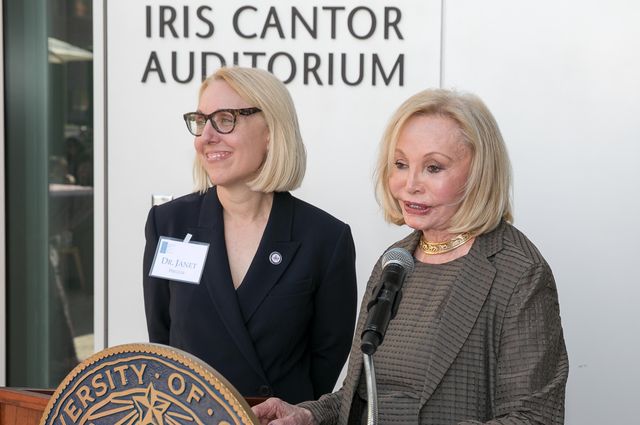
In 2002, Iris brought the model to New York with the Iris Cantor Women’s Health Center at NewYork-Presbyterian/Weill Cornell. Within a few years, it had served close to 90,000 patients. In 2025, UCLA and the Foundation marked 30 years of the Los Angeles center. Its director, Dr. Janet Pregler, has credited Iris’s advocacy with shaping care for tens of thousands of women.

Following the patients
One of the most telling moments in Iris’s story came from an unexpected place. Within a decade of opening, about 40 percent of the patients at the New York women’s center were men. The convenience and coordination she had designed for women turned out to be what many men wanted too.
Iris treated that as a signal, not a complication. She went on to establish the Iris Cantor Men’s Health Center at NewYork-Presbyterian, the first facility of its kind in the New York region. Behind all three centers was a principle she championed early: men and women have different medical needs, and both are best served by care designed around them, with an emphasis on prevention and treating the whole person.
A legacy that still opens its doors every day
Nearly forty years after the first imaging center opened at UCLA, the Iris Cantor name remains on clinics in Los Angeles and New York, where women still come in for screenings, follow-up imaging, and care every day. Her work is not a memorial; it is a functioning part of the health system.
Working at the Iris & B. Gerald Cantor Foundation, I’ve come to see that Iris’s approach was never only about funding buildings. She identified a gap, built something to close it, and kept paying attention as patients showed her what they needed next. That combination of conviction and listening is what made her impact last.
No Comments